


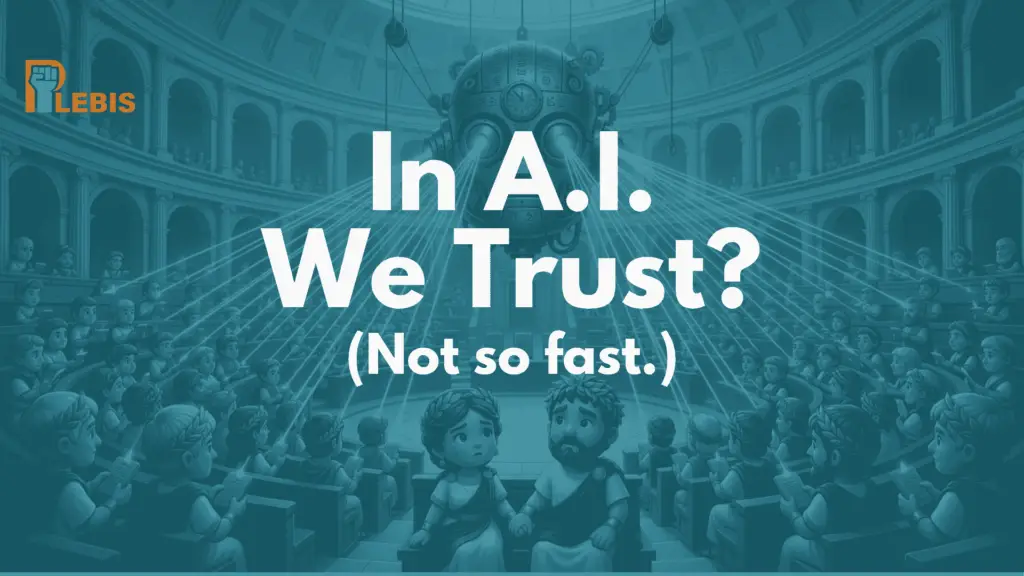
The rise of autonomous AI agents in blockchain governance, and why intelligence should serve the people, not replace them.
Something strange is happening in blockchain governance. The same communities that spent a decade fighting to decentralize power away from institutions are now building systems to hand decision-making to machines.
Not tools. Not assistants. Voters.
In February 2026, Ethereum co-founder Vitalik Buterin published a proposal for what he called “AI stewards,” personal agents trained on a user’s writing, conversation history, and stated values that would cast governance votes on their behalf. The framing was characteristically practical: there are too many proposals, too many chains, too many decisions for any single person to track. Human attention is the bottleneck. AI is the fix.
Around the same time, NEAR Protocol announced its “House of Stake” governance framework, which includes AI Assistants, AI Delegates that vote autonomously based on pre-agreed principles, and a prototype AI CEO capable of making strategic resource allocation decisions for the community. Lane Rettig, a researcher at the Near Foundation, described the endgame in plain terms: “replace all human actors with a digital twin” to solve the voter apathy problem. Governance, he said, becomes “a math problem.”
These are not fringe experiments. The AILVE DAO has already launched an AI Agent Committee, a collective of specialized AI agents forming an actual decision-making body. Researchers at Columbia and IBM built DAO-AI, an agentic voter tested on over 3,000 proposals from major protocols, and found it aligned closely with human outcomes. The academic paper framing it was careful, even cautious, but the implications are not: autonomous AI can approximate collective reasoning at scale, and the technology to deploy it already exists.
The question is whether it should.
Don’t take humans out of the blockchain governance loop
At Plebis, we built our platform around a specific conviction: governance participants deserve better intelligence, not less agency. The Plebis Oracle exists on every page of the platform for exactly this reason. It summarizes proposals. It runs sentiment analysis across Vox Populi discussions. It answers natural-language questions about governance activity across our MVP set of 8 Cosmos chains. It does the reading so that Plebeians, the community members who show up, who earn their Tributes, who cast actual votes, can make sharper decisions faster.
That is a fundamentally different thing from casting the vote itself.
The distinction matters more than it might seem.
To understand why the push toward AI voting has accelerated, you have to look at the numbers. Average participation rates in DAO governance hover between 7% and 10% of token holders. In many protocols, the figure is closer to 2-5%. The proposals are dense, technical, and frequent. Most token holders never read the forum threads. They never evaluate parameter changes. They delegate to a handful of visible participants and forget about it.
This is the problem Buterin identified, and he is right that it is serious. Delegation concentrates power. A small group of delegates ends up controlling decision-making while their supporters, as Buterin put it, “have no influence at all.” In the worst case, this dynamic makes governance attacks viable. A bad actor with enough tokens can push through a damaging proposal while the rest of the community is disengaged.
The Arbitrum DAO learned this the hard way in April 2025. A user called hitmonlee.eth spent 5 ETH, roughly $10,000, on a platform called LobbyFi to purchase 19.3 million ARB tokens’ worth of voting power. That was more than the voting power held by major delegates like Wintermute or L2Beat. The votes were used to secure a committee seat worth 66 ETH over twelve months. The cost of influence: pennies on the dollar.
The incident triggered a governance crisis. The Arbitrum Foundation launched a public forum discussion. Community members proposed disqualifying purchased votes, routing funds through trusted multisigs, even banning the practice outright. But every proposed fix introduced trade-offs between decentralization, security, and fairness. No clean answer emerged.
This is the environment AI voting proponents are responding to. Governance is fragile. Participation is low. The attack surface is large. And the argument for automation is simple: if humans will not do it, let the machines handle it.
But the cure introduces its own blockchain governance pathology.
Consider what Buterin’s proposal actually requires. Each user deploys a personal AI model trained on their preferences. That model votes across thousands of proposals, across multiple domains of expertise, continuously. When it is uncertain, it escalates to the human. Otherwise, it acts alone.
The privacy architecture is sophisticated. Zero-knowledge proofs protect voter identity. Trusted execution environments keep sensitive data sealed. Prediction markets filter spam proposals. On paper, it is elegant. In practice, it raises questions that the crypto space has barely begun to answer.
Who is accountable when an AI agent votes for something that damages a protocol? The user who trained it? The model developer? The DAO that accepted the vote? If an AI hallucinates, misreads a proposal’s technical implications, or gets exploited through adversarial prompt injection, the damage is done before anyone notices. And unlike a human delegate, an AI agent does not face social consequences. It does not lose reputation. It does not have to explain itself in a forum thread.
The DAO-AI research found strong alignment between AI decisions and human outcomes, which sounds reassuring until you consider what alignment means here. The AI is trained on historical voting data. It learns what communities have decided in the past and replicates those patterns. That is pattern-matching, not judgment. It cannot distinguish between a community that voted wisely and one that voted out of inertia, tribalism, or incomplete information. It flattens the difference between consensus and groupthink.
There is also the concentration problem. If most users deploy AI agents built on the same foundation models, trained on similar data, the diversity of perspectives that decentralized governance is supposed to protect collapses. You end up with thousands of agents that think alike, voting in near-lockstep, generating an illusion of broad participation while the actual decision surface narrows to whatever the model’s training data reflects.
NEAR’s vision pushes this further. If governance becomes “a math problem,” if every vote resolves almost instantly because digital twins already know how everyone will vote, then what you have built is not a democracy. It is a prediction engine wearing the costume of one.
The real tension here is not between efficiency and decentralization. It is between intelligence and agency.
Intelligence is what you need before you vote. It is proposal summaries, risk scoring, sentiment analysis, cross-chain comparables, turnout trends, validator performance data. It is the ability to understand what is happening, why it matters, and what the trade-offs look like. This is what governance intelligence platforms exist to provide.
Agency is the vote itself. The act of choosing. The willingness to show up, engage, and take responsibility for the outcome.
When you walk into the Circus Maximus on Plebis and see participation rates compared across ecosystems, you are looking at agency made visible. When you check a validator’s Plebis Grade, you are using intelligence to inform your own judgment about who deserves your delegation. When you search The Library’s archive of over 2,400 proposals, you are doing the work of an informed citizen. When the Plebis Oracle surfaces a sentiment shift in a Vox Populi discussion, it is handing you a signal, not making a decision for you.
The Leading Citizens who top the leaderboard did not get there by outsourcing their participation. They earned their Tributes through votes cast, proposals submitted, deposits made, communities engaged. That is what governance participation looks like when it is real.
AI can make all of this better. It already does. Proposal analysis that would take hours can be summarized in seconds. Patterns across chains that no human could track manually become visible through analytics like the Governance Health Score, the Ecosystem Turnout Index, the Staking Activity Index. The Plebis Oracle can answer questions in natural language that would otherwise require digging through pages of on-chain data.
None of that requires the AI to vote.
Is there a middle road?
There is a version of this future that works. Buterin hinted at it when he described AI agents that escalate critical decisions to humans. NEAR acknowledged it when Rettig said he is “a firm believer that there should always be a human in the loop” for high-stakes calls like fund allocations or strategic pivots. The DAO-AI researchers were explicit: their system “does not prove that artificial agents make better decisions.” It only shows they can approximate collective reasoning.
The productive path is hybrid: AI that handles the reading, the analysis, the pattern detection, the risk flagging, the summarization, while humans retain the authority to decide. Not because humans are infallible, but because the act of deciding is what makes governance meaningful. Remove the human from the vote and you have optimized the process at the cost of the principle.
Blockchain governance was supposed to be the mechanism through which communities exercise collective self-determination. The entire architecture, the proposals, the forums, the quorums, the on-chain records, exists to give people a voice. Vox Populi. The voice of the people.
Not the voice of their models.
The technology to automate voting in blockchain governance is here. The platforms are live, the research is published, the frameworks are being built. This is not a question of capability. It is a question of what we are willing to give up in exchange for convenience.
At Plebis, our answer is clear. We built the Oracle to make Plebeians smarter, not to make them unnecessary. We track Tributes because participation should be earned, not delegated to a language model. We score validators with the Plebis Grade because accountability requires a human on the other end. We built Insight and Analytics, the CMSI, the SAI, the ETI, the GHS, because informed communities make better decisions than automated ones.
Intelligence is the tool. The vote is the human act.
We say Power to the People. Not Power to the Agents.
Want to experience Plebis for yourself? Head on over to Pleb.is and get a taste of what blockchain governance intelligence looks like.
We’re trying to solve a myriad problems that blockchain governance faces if you haven’t read our blog post “Why blockchain governance is broken.” You should.
Get the latest blockchain governance news and what’s happening within the ecosystems that we support by signing up for our newsletter.